
Alex Cerqueira de Araujo*
Senior Bioinformatician
Sumner Lab · UCLCurrent group
- Position
- Senior bioinformatician
- In the lab
- September 2024–present
- Contact
About
Background
I am a French researcher specialising in evolutionary biology and bioinformatics. I earned my PhD in molecular biology at the University of Tours (France), supervised by Prof Huguet and Dr Josse.
My research background focuses on evolutionary biology, leveraging genomic data to uncover insights into the evolutionary processes shaping organisms. During my PhD I explored the evolutionary dynamics of viral symbiosis in parasitoid wasps, providing insights into the interactions between wasp and viral genomes and their impact on wasp biology. Afterwards, through comparative genomics, I studied tick genome evolution, which highlighted features such as gene expansions that support their parasitic lifestyle. Beyond my primary research projects, I’ve shared my bioinformatics expertise with students and researchers, contributing to multiple publications, and taught genetics and basic evolution concepts to undergraduates.
My study approaches integrate molecular and evolutionary biology, bioinformatics, and functional and comparative genomics.
Research interests
My work focuses on the evolution of organisms, especially the evolution of arthropod genomes.
I use genomic, transcriptomic and proteomic data to find evolutionary patterns among species. These patterns can take several forms, from single nucleotide polymorphisms to chromosome structural changes — they help me better understand the link between genome and phenotype, and to draw evolutionary relationships between organisms. In combination with phenotypic features, genomic features can also be used to predict species life-history traits and evaluate species susceptibility to, for example, environmental change.
Other interests
I like arthropods! so I draw them and make 3D models out of them. 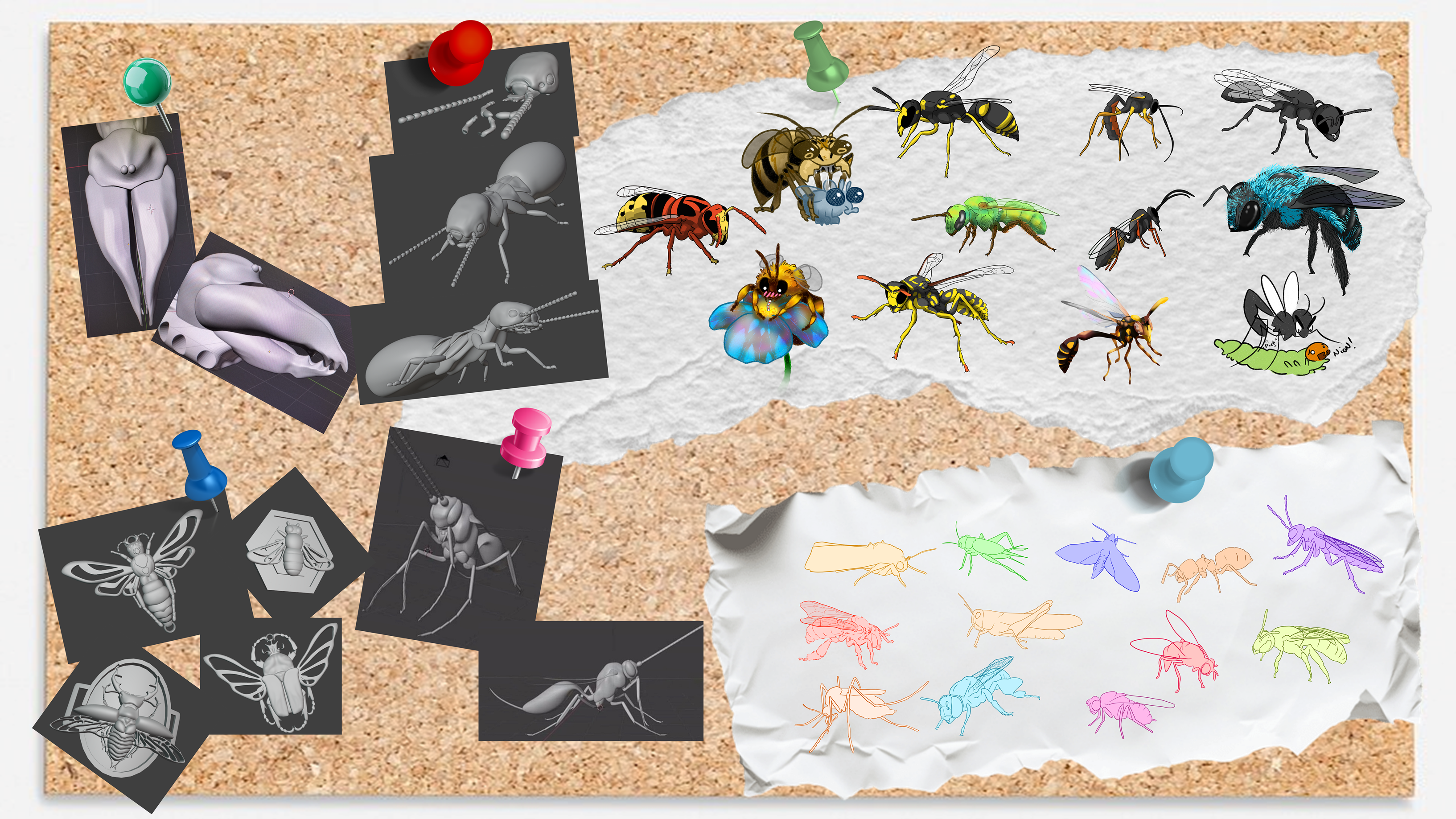
Research
Career
- Sept 2024–present: Postdoctoral researcher, UCL, UK
- Apr 2024-May 2024: Molecular phylogeny course - advanced, France
- Jan 2024-Feb 2024: Visiting researcher, Czech Academy of Sciences, Czech Republic
- Jan 2023–Jun 2024: Postdoctoral researcher, INRAE-Oniris, France
- Feb 2019-Mar 2019: Bioinformatic courses, Agrocampus, Rennes, France
- Sept 2018–Jul 2022: PhD in Science (Biology), Université de Tours, France
- Feb 2018-Jul 2018: Master 2 internship, Université de Poitiers, France
- Feb 2017-Jul 2017: Master 2 internship, Université de Poitiers, France
- May 2016-Jul 2016: Master 1 internship, Université d’Orsay, France
- Sept 2015–Jun 2018: MSc in Evolutionary Ecology, Université Paris-Saclay, France
- May 2015-Jul 2015: Internship, Université d’Orsay, France
- Sept 2012–Jun 2015: Bachelor of science degree in biology, Université de Poitiers, France
Projects
Comparative genomics and evolution of hymenopterans
One of my main goals is to build a genome-scale evolutionary genomics pipeline (300+ assemblies) covering assembly QC, repeat annotation, structural/functional gene annotation, orthology, phylogenetics, synteny, and selection analysis.
Past projects
Comparative and evolutionary genomics of ticks
I was a key contributor to a comparative genomics project generating chromosome-level assemblies for four Ixodes tick species, including I. ricinus, the main vector of Lyme disease, and using them to study tick genome architecture and long-term evolutionary history — a foundational piece of work that gave the field genomic resources for this genus. Building on that work, I turned to horizontal gene transfer (HGT) from bacteria into tick genomes. I identified several genes originating from HGTs. Among them, a bacterial gene (AnmK), normally involved in recycling bacterial cell-wall material, was acquired by the common ancestor of all ticks and has since become functionally integrated into tick biology.
 Figure legend: Evolution of tick genomes. Top: Chromosome syntenies between Ixodes ricinus (orange) and Ixodes scapularis (purple-blue). Centre left: phylogeny of Ixodidae. Node circles show the gene family expansions (blue: expanding, red: contracting). The numbers represent the number of expanded (+) / contracted (-) gene families and the number of gained (green) gene families. Symbols represent □ Ixodidae, Δ Metastriata, ○ Prostriata, ∇ Ixodes hexagonus, ⋄ Other Ixodes. Centre right: GO terms associated to expanded families in the Ixodidae tree (centre left). Symbols correspond to symbols on the tree. Bottom: Gene tree of cytosolic sulfotransferases. Label prefixes correspond to each species: the tick I. ricinus (SFT, labels in blue), the spider Parasteatoda tepidariorum (ptepid), the horse-shoe crab Limulus polyphemus (limulus), human and Drosophila melanogaster (dmel). The chromosomal localization (scaffold number) is indicated in the first outer circle. The next outer circle are bar-charts of the number of coding exons (dark-gray filling) and 5′ UTR-only exons (orange filling).
Evolution of viral domestication in Campopleginae wasps
During my PhD, I studied how parasitoid wasps domesticate viruses, turning them into weapons against the insects they parasitize. Working mainly on Campopleginae wasps like Venturia canescens, I showed that conserved, domesticated viral transcriptional machinery drives the production of virus-like particles (VLPs), which help wasp larvae suppress their host’s immune defenses. I described two other endogenous nudiviruses, one endogenised in Campoplex capitator, the other one endogenised in Campoplex nolae, and traced how this nudivirus-derived VLP system evolved in this group of wasps. In a comparative follow-up, I found that unrelated domesticated viral lineages — nudivirus-derived VLPs in Campoplex wasps and ichnoviruses — had independently and convergently recruited the same proteins (transcribed from repeat element genes), suggesting there’s a shared evolutionary “toolkit” that different wasp lineages draw on when domesticating viruses.
 Figure legend: Evolution of Nudiviruses endogenised in Campopleginae wasps. Top left: dNdS ratios of viral (red, green, pink and blue) and wasp genes (grey). Top right: Syntenies of viral genes endogenised in two different species of wasps (Venturia canescens and Campoplex capitator). Viral genes are colored (yellow for lost genes by pseudogenisation) while wasp genes are white/grey. Bottom left: phylogeny of Naldaviricetes. Nudiviruses endogenised in Campopleginae are written in red (CnolaENV: Campoplex nolae Endogenous Nudivirus, CcapiENV: Campoplex capitator Endogenous Nudivirus, VcENV: Venturia canescens Endogenous Nudivirus). Bottom right: expression kinetic of viral genes and virulence factors (wasp genes envelopped in Virus-Like Particles - VLPs) in Venturia canescens. P1 to P5 refer to nymphal instars, where the VLP production is low compared to the adults.
Publications
Scopus-indexed articles and preprints
This list is refreshed automatically from the Scopus author profile.
-
Cerqueira de Araujo A, Noel B, Bretaudeau A, Labadie K, Boudet M, Tadrent N, Istace B, Kritli S, Cruaud C, Olaso R, Deleuze J-F, Voordouw M, Hervet C, Plantard O, Zamoto-Niikura A, Chertemps T, Maibeche M, Hilliou F, Le Goff G, Chmelar J, Mazak V, Jmel MA, Kotsyfakis M, Medina JM, Hackenberg M, Simo L, Koutroumpa FA, Wincker P, Kopacek P, Perner J, Aury J-M, Rispe C. 2025. Genome sequences of four Ixodes species expands understanding of tick evolution. BMC Biology. https://doi.org/10.1186/s12915-025-02121-1
-
Pienaar RD, Herrero S, Cerqueira de Araujo A, Krupa F, Abd-Alla AMM, Herniou EA. 2024. Optimization of screening methods leads to the discovery of new viruses in black soldier flies (Hermetia illucens). bioRxiv. https://doi.org/10.1101/2024.08.27.609913
-
Cerqueira de Araujo A, Leobold M, Cariou M, Ferreira dos Santos B, Uzbekov R, Ricciardi R, Scaramozzino P, Lucchi A, Musset K, Drezen J-M, Josse T, Huguet E. 2023. Rep virulence genes have been recruited convergently by nudivirus-derived Virus-Like Particles and ichnoviruses of Campoplegine wasps. bioRxiv. https://doi.org/10.1101/2023.12.12.569846
-
Cerqueira de Araujo A, Josse T, Sibut V, Urabe M, Asadullah A, Barbe V, Nakai M, Huguet E, Periquet G, Drezen J-M. 2022. Chelonus inanitus bracovirus encodes lineage specific proteins and truncated immune IkB-like factors. Journal of General Virology. https://doi.org/10.1099/jgv.0.001791
-
Cerqueira de Araujo A, Leobold M, Bezier A, Musset K, Uzbekov R, Volkoff A-N, Drezen J-M, Huguet E, Josse T. 2022. Conserved viral transcription plays a key role in virus-like particle production of the parasitoid wasp Venturia canescens. Journal of Virology. https://doi.org/10.1128/jvi.00524-22
-
Cerqueira de Araujo A, Huguet E, Herniou EA, Drezen J-M, Josse T. 2022. Transposable element repression using piRNAs, and its relevance to endogenous viral elements (EVEs) and immunity in insects. Current Opinion in Insect Science. https://doi.org/10.1016/j.cois.2021.100876
-
Prigot-Maurice C, Cerqueira de Araujo A, Beltran-Bech S, Braquart-Varnier C. 2021. Immune priming depends on age, sex and Wolbachia in the interaction between Armadillidium vulgare and Salmonella. Journal of Evolutionary Biology. https://doi.org/10.1111/jeb.13721
-
Prigot-Maurice C, Cerqueira de Araujo A, Durand S, Laverre T, Pigeault R, Verdon J, Bulet P, Beltran-Bech S, Braquart-Varnier C. 2019. Survival capacity of the common woodlouse Armadillidium vulgare is improved with a second infection of Salmonella enterica. Journal of Invertebrate Pathology. https://doi.org/10.1016/j.jip.2019.107278
Book chapter
- Hulot F and Cerqueira de Araujo A. “Effets des cyanotoxines sur les communautés zooplanctoniques en milieu lentique.” In: Bernard, C., Mougin, C. and Pery, A. (eds) Écotoxicologie, des communautés au fonctionnement des écosystèmes. ISTE, 2017, pp. 137–152.